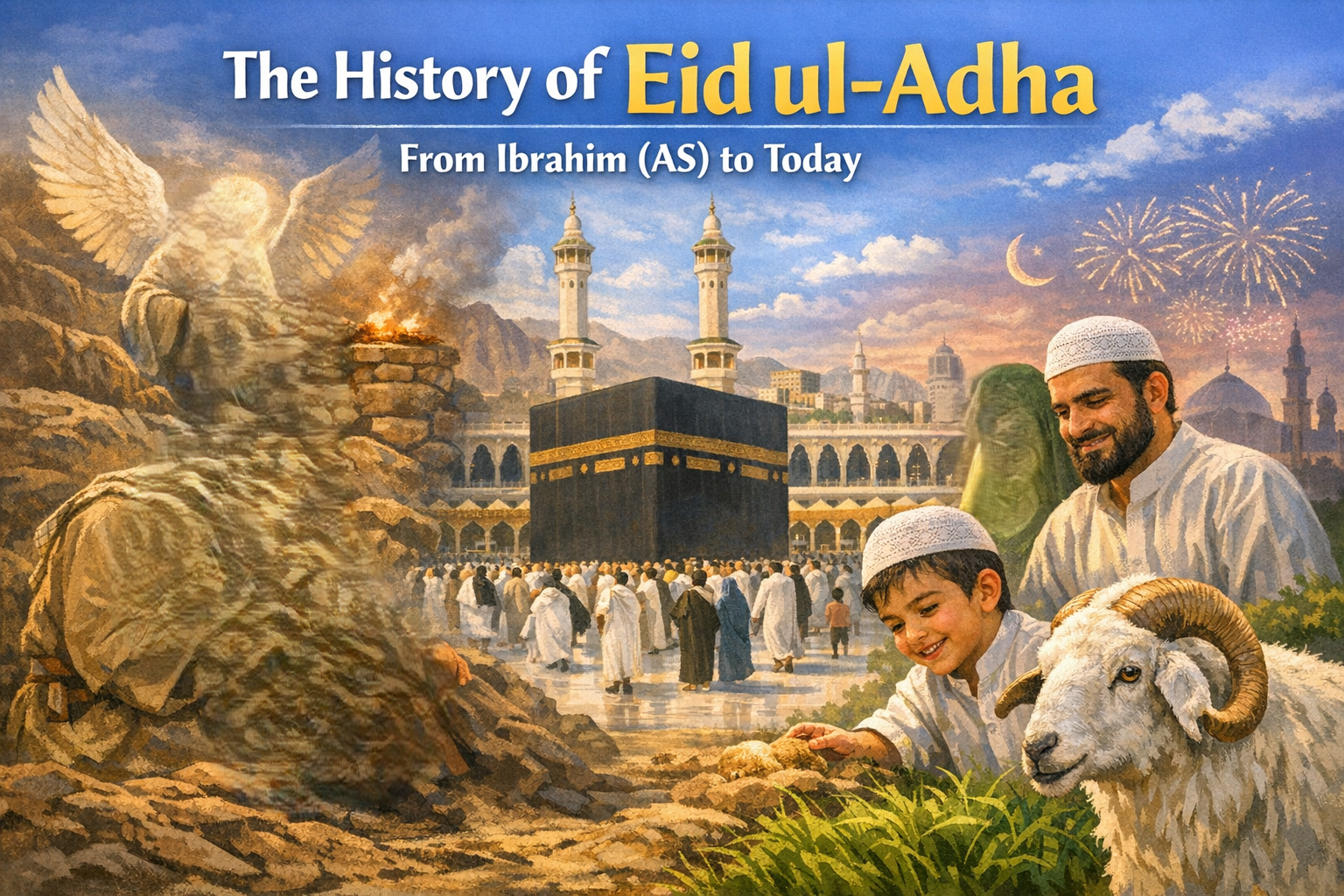
The History of Eid ul‑Adha — From Ibrahim (AS) to the Present Day
Eid ul‑Adha, known as “The Festival of Sacrifice,” stands among the most meaningful observances in the Islamic calendar. Its origins trace back thousands of years to the time of Prophet Ibrahim (AS), whose unwavering devotion to Allah became a defining symbol of faith. Today, Muslims across the world honor that legacy through prayer, charity, and the ritual of Qurbani.
This is the story of how it all began — and how it continues to shape Muslim life today.
The Beginning: Ibrahim (AS) and the Ultimate Test
The history of Eid ul‑Adha is rooted in the life of Prophet Ibrahim (AS), a man known for his profound faith. One night, he saw a dream — a divine command — instructing him to sacrifice his beloved son, Ismail (AS). For prophets, dreams are a form of revelation, and Ibrahim (AS) understood that this was no ordinary vision.
What makes this moment extraordinary is not only Ibrahim’s obedience, but also Ismail’s response. When told of the dream, the young Ismail (AS) replied with maturity and trust:
“Father, do as you are commanded. You will find me, if Allah wills, among the patient.”
This exchange captures the essence of submission — a father and son united in their devotion to Allah.
A Divine Intervention: The Ram from Heaven
As Ibrahim (AS) prepared to carry out the command, Allah replaced Ismail (AS) with a ram from the heavens. This miracle signified three things:
Ibrahim (AS) had fulfilled the test of faith
Ismail (AS) was spared
Sacrifice became a symbol of devotion, not the taking of human life
This moment is commemorated every year through Qurbani, reminding Muslims that true sacrifice lies in sincerity, obedience, and gratitude.
How the Tradition Continued Through Generations
The practice of sacrifice continued through the prophets and became deeply embedded in Islamic tradition. When Prophet Muhammad (SAW) revived the rituals of Hajj, he emphasized Qurbani as a way to honor Ibrahim’s legacy.
Over time, Eid ul‑Adha evolved into a global celebration marked by:
Eid prayers in mosques and open grounds
Qurbani of animals such as goats, sheep, cows, and camels
Distribution of meat to family, neighbors, and especially those in need
Acts of charity, unity, and gratitude
Yet the message remained unchanged: faith, sacrifice, and compassion.
Eid ul‑Adha in the Modern Era
Today, more than a billion Muslims celebrate Eid ul‑Adha across continents. While the core rituals remain the same, the way Qurbani is performed has adapted to modern life.
Contemporary practices include:
Online Qurbani services
Organized and hygienic slaughterhouses
Structured meat distribution
International charity initiatives
Digital tracking and transparency
Despite these advancements, the heart of Eid ul‑Adha remains rooted in the values taught by Ibrahim (AS):
Submission to Allah
Willingness to sacrifice
Care for the less fortunate
Unity within families and communities
Why Eid ul‑Adha Still Matters
In a fast‑moving world, Eid ul‑Adha brings us back to timeless truths:
Faith requires trust
Blessings require gratitude
Wealth requires sharing
Love requires sacrifice
It is a celebration that connects the past with the present — a bridge between the story of Ibrahim (AS) and the lives of Muslims today.
Final Reflections
Eid ul‑Adha is more than a ritual; it is a story of devotion that has shaped Islamic identity for centuries. From the deserts of ancient Arabia to the cities and villages of the modern world, its message endures:
True sacrifice is not about what we give up, but the sincerity with which we give.
Comments (0)
No comments yet. Be the first to comment!
Leave a Comment
Your comment will be visible after approval.